
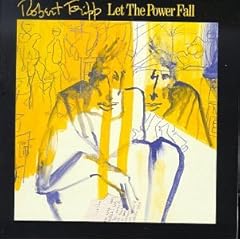
Out-of-print 1981 solo album by avant guitar virtuoso Robert Fripp, introduced to me by Maya M.
For the sake of my own and the reader's sanity, those seeking biographical information on this visionary and multifaceted artist are advised to visit a site called "Elephant Talk". Suffice to say that Fripp, who lives among us even now, is well-known for what is called "Frippertronics", the use of a very particular set-up of tape loops and other such equipment in order to transform the solo performance of an electric guitar into an expansive field of soothing ambient vibrations.
This album has garish 80s cover art. This album is also really good, and is definitely up there with top five chill hard records ever. It is also highly effective for promoting serenity of mind in the workplace or any long period of time spent staring at a small electronic screen.
In other words, it serves as a great sonic remedy to Blaise Pascal's aphorism that "all men's miseries derive from not being able to sit in a quiet room alone."
I also had to reflect on what the title meant, and I decided that it maybe refers to the act of musical improvisation. First of all, successful improv means not using power, if by power you mean controlling things and knowing all the time what's going to happen. So the power has to fall or otherwise be deposed. Now the problem with this is, how to depose power without power returning via the deposition. You may think you get out of it, but the getting out of it turns out to be just a really great way to stay in it. Because power isn't just happy being power, it wants to take control of not-power also.
So you want power to fall, but you can't just push it over, you have to find a way to let it fall. But the beauty of this fall, its aesthetic component, isn't when power is lying all gross and smashed on the ground like a dead bird, but, as in Fripp's case, in the gloriously long decline itself, maybe so long that it never ends, which is what this album sounds like, like power falling forever, across infinity.
Let the Power Fall: http://www.divshare.com/download/4536838-359
And additionally, for those already versed, this unofficial 1975 Live Paris bootleg with Brian Eno is made available. A two-disc set, the tracks, which run the gamut of Fripp's officially released studio output together with Eno, are listed only as S 1-4.
Air Structures: http://www.divshare.com/download/4538141-17f
Monday, May 19, 2008
Robert Fripp: Let the Power Fall & Air Structures


Monday, May 12, 2008
Epic Soundtracks / Turkish Star Wars
*For more on 60s/70s cult soundtracks see http://www.scorebaby.com
BUT FIRST
before the main event, a perverse appetizer, one long overdue for classical acknowledgment.
Dünyayı Kurtaran Adam (The Man Who Saves the World) is a 1982 Turkish film, part of a wave of low-budget productions from the region which slavishly and at times bizarrely imitated American Hollywood blockbusters, occasionally resorting to flat-out stealing clips from the originals when necessary. The Man Who Saves the World is thus referred to as "Turkish Star Wars", there are likewise Turkish Superman, Star Trek, etc - also Turkish E.T., in which the title character appears not as a lovable, charming plush-toy creature, but a lop-sided, flatulent space potato whose visage makes you cringe when the children hug it.
What is awesome about this clip from Turkish Star Wars shouldn't require much more explanation on my part. I will note that globally speaking, Americans are in the unique position of seeing their own culture bootlegged, imitated, xeroxed into oblivion, more than any other nationality. Like when you go to the market in Marrakesh and they're selling Beebok shoes and it's really funny. I am secretly grateful as an American that there is not some other larger, more cultural impactful country than my own that causes me constant anxiety of influence, whose pop culture I dearly love like delicious junk food but despise and need to distance myself from at the same time.
Thus part of America's cultural fate is the uncanny encounter with stuff like Turkish Star Wars, where we get our own bullshit thrown back at ourselves in mutant form.
By the way, these Turkish films often snip hodge-podge from American soundtracks, throwing them altogether for fun, you can recognize for example "Battlestar Galactica" in the following clip:
NOW, AC STEREO, MAY EDITION: EPIC SOUNDTRACKS
These are psychedelically epic, in contrast to either heroically or romantically. I wanted to put some Phillip Glass here but I couldn't download any from itunes and don't own any, inexplicably. The following line-up contains a lot of usual suspects, most of whom are prolific enough to justify combing through some odder folds in the back catalog. Comments appear below, followed by a massive dose of carefully curated clips.
1. Tangerine Dream - Beach Scene (from Thief)
80s synth-soundtrack warlords whose resume in this field is too epic for consideration. Alex B gave me this track, from Michael Mann's Thief, which plays right after James Caan, the titular thief of banks, has just pulled off the sickest heist ever, and he gets to go celebrate on the beach with his woman and James Belushi.
2. Christian Bruhn - Aravanadi - der Baron
Bruhn is a 70s-80s German soundtrack composer, this is for a German kid's TV series called Timm Thaler, an update of the Faust narrative in which the title character sells his laughter to the Baron LeFuet (anagram of "Teufel", German for "Devil").
3. Bo Hansson - Black Riders & Flight to the Ford
Not really for an actual soundtrack, and we've covered it before, but dammit, it's a 70s swedish-prog imaginary soundtrack to Lord of the Rings, and it rules.
4. Ennio Morricone - Fuggire Lontano
A deep boogie TV cue. I don't know much about it. I do know that you should probably get the two-disc "Crime and Dissonance" set that came out a few years ago, because it is well-bugged.
5. Freedom Orchestra - Lucifer Rising, Part I
Part of Kenneth Anger's classic 60s psychedelic Satan movie. The soundtrack was going to be by Jimmy Page originally, but it finally fell to Bobby Beausoleil, who I think recorded part of it in prison or something. Nicely evil. Like not too much evil, like when you eat too much Oatmeal Cookie Chunk ice cream and you lie there like a sickly, friendless whale and think you might barf.
Psst: here's the whole soundtrack. It's a bit mud-fi, but pretty much as triumphantly psych-evil as you're going to get.
Freedom Orchestra - Lucifer Rising
6. Popol Vuh - Aguirre II
From Herzog's film Aguire: The Wrath of God, accompanies the insanely beautiful opening shot. Both Popol Vuh and Herzog have a similar artistic strength, that of engaging with romantic/exoticist/hippie types of tropes and traversing them until they become something beautifully otherworldly. PS: the next time someone in casual conversation disparages the Mellotron, play them this haunting, distant choir that spreads its alien angelic beauty all through the heavens.
7. Goblin - Patrick
Pretty much the best epic soundtrack group ever. I mean, "Suspira"? Those crazy bells and shit? "Patrick" is from the movie of the same name. Guess what? Quiet Village ripped it off for their track "Pillow Talk". They took the scary warbliness out of it and made it a super-chill yacht jam.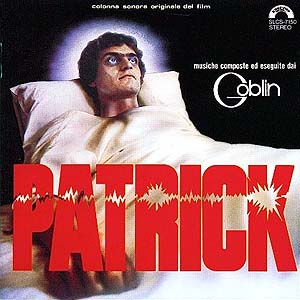
8. Terry Riley - In the Summer
From some ponderous 70s eurotrash movie called "Lifespan" starring Klaus Kinski. One of the minimalist master's only film compositions, it's also I think the only track by him that has vocals on it.
9. Giorgio Moroder - Paul's Theme (Jogging Chase) From "Cat People"
Ok do I have to explain who he is? He's like Goethe, he pretty much invented everything. Plus, he produced not only "Take My Breath Away" from Top Gun, but "Call Me" by Blondie from American Gigolo. Damn.
10. Tully - Follow Me from "Sea of Joy"
Some hippie-dip soundtrack to an old Australian surfing movie. I bought this for some reason at Other Music, weirdly mesmerized by the accompanying description, despite the fact that 1. I don't care about hippie-dip folkie folk and 2., it's about surfing in Australia. In any case, most of the soundtrack is a wash, except for this track, because it is suitable moody and dark, and thus epic.
11. Marc Wilkinson - Fiend Discovered and Titles from "Blood on Satan's Claw"
We close with some actual orchestral soundtrack stuff, from a 70s British horror film not dissimilar from "The Wicker Man". Also the soundtrack has nice track titles like "Claw in the Classroom."
Now please enjoy some audio/visual excursions. Where possible, the clips reflect the aforementioned tracks, sometimes they don't because this was not possible, or because I don't care.
Opening to "Lucifer Rising"
Beach Scene from "Thief"
Opening shot from "Aguirre: The Wrath of God"
Final Episode 13 of "Timm Thaler"
"Blood on Satan's Claw"
Dream Sequence from "Cat People"



Sunday, April 27, 2008
Smooth Sciences: An Introduction
Wong Kar-Wai, "2046"
One of this site's guiding principles is to avoid posting entire albums. The reasoning behind this is evident in its exceptions. An entire album may be posted without derision or scorn here only when it is out of print or otherwise difficult to obtain. Or, lastly, when it is really important to do so. Because music, the most incorporeal of the arts, not only sooths beasts, on humans it can as well compel and possess.
Inundated as we are with dystopic images of future days, it was striking to watch the future-segment of "2046" and encounter a tomorrow that seemed beautiful, naive, decadent, suffused with the neon streaks of an opiate light. Not a political warning or cultural satire, or PKD-style engagement with the schizo-dissociative powers of technology, just a completely oneiric escapist fashion-magazine spread, one that produces a radiant digital narcosis.
So here now are three works that can be said to intersect with such a dose of bright tomorrows:
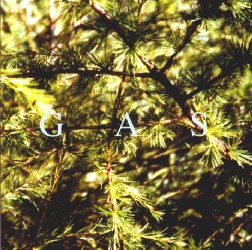
Gas - Pop
"I believe in the signal of the bass drum. It it the heartbeat of my life." - Wolfgang Voigt, aka Gas, Mono.Kultur #08
The real name of ambient-techno artist Gas is Wolfgang Voigt. Voigt is the co-founder and co-owner of Kompakt records, and is a highly influential and prolific electronic musician.
There's much that can be said about the maternal heart-pulse of the techno bass drum, and as well for the warm, pulsating, embryonic womb that the well sound-system'ed club attempts to emulate (Fabric Room One, for example). This sound is compelling enough that it can keep me in its sonic amniotic suspension for minutes at a time, until the spell is broken and I am reminded that I'm in a weird dingy club in the immediate vicinity of NYU, surrounded by total randos.
A new luxurious Gas boxed set will soon be released, meaning that technically Pop still remains out of print, and well within an acceptable domain of full-album posts.
As for a description of this record, we would be hard-pressed to beat Voigt's own, from the same interview:
"I had an image in my mind of a gaseous and nebulous sound, of an exhilarating streaming music which literally flows over, which has no beginning or end no hard edges, only softness. My association was this music drifting through the coppice of a misty wood in vast sound spheres, a very elegaic sound repeated over and over in the far distance, held together by an invisible bass drum that comes marching by somewhere hidden in the woods coming closer and fading away again."
It's an amazing sunday sunset record, preferably one of those hazy interminable twilights, one of those blue-gray and feathery evening come downs.
In a sense, The Field is a kind of punk reduction of Gas's near-classical sense of dynamics and ornament - The Field takes up this loop-based ambient techno approach and fidelities it way down, brutes it up, takes it from the Germanic sylvan idyll and kicks it back into the city streets.
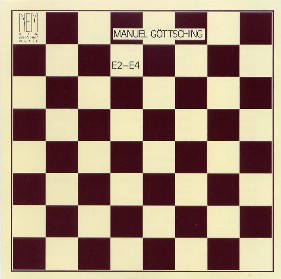
Manuel Gottsching "E2-E4"
So in the case of these records, geography is everything. Gas is the Germanic sylvan idyll, when you're out stamping in boots for boar among the brush.
e2-e4 is a beach record. Recorded in 1981 in Berlin on a two-track in one take by Gottsching, guitarist for supreme face-melters Ash Ra Tempel, it effectively helped invent techno music. It consists only of an unspooling of an infinite synth, and the soaring, tremulous clusters of an electric guitar windblown across the waters. Like Gas, it doesn't ever seem to be going anywhere, but unfurls blissfully in place. Again, the timelessness of the womb, the sublime "oceanic feeling" that Freud describes in Civilization and Its Discontents.
E2-e4 is often regarded as a founding track of Balearic, which is an extremely broad dance category, but generally associated with electronic beach beats. It covers everything from trippy yacht disco to the filth enjoyed by the worst baggy bepanted pill poppers the imagination can conjure.
The Guardian ran this article on the Balearic resurgence a few months ago. The descriptions of the DJing style parallel those describing Baldelli's sets at Cosmic, which marked the birth of 'cosmic disco': slow (11obpm or so), eclectic, an emphasis on experimentalism and texture.
http://arts.guardian.co.uk/filmandmusic/story/0,,2253890,00.html#article_continue
Vangelis - "Memories of Green"
The original version of "Memories of Green", which would later appear in rerecorded form on the Blade Runner soundtrack, here taken from Vangelis' 1980 album, See You Later. The soundtrack's voluptous digital sheen is absent here, leaving behind the hairier, lower-fi predecessor.


Monday, April 21, 2008
Endless Grift: Got Live If You Want It
ENDLESS GRIFT
TOMORROW
TUESDAY APRIL 22ND 10PM
Parkside Lounge, 317 E. Houston
Entrance Fee: No Dollars
CHRIS ALEX BILLY
CHROME EAGLE SOARING