
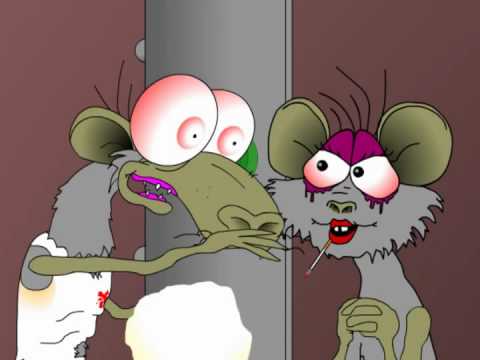
With uncanny timing, the latest episode of South Park comes on the heels of a recently-published scientific report comparing the addictive quality of junk food to that of cocaine.
Published in Nature Neuroscience, the study, in which different groups of lab rats were tested for their responses to healthy and junk food diets, supports the idea that "compulsive-like eating behavior can emerge in extended-access rats in a manner analogous to the compulsive cocaine-taking seen in rats with a history of extended access to the drug." Seems the group of rats given only junk food became addicted enough that the rats would ignore deterrents like electric shocks in order to get their fix. The scientists build an analogy: today's junk food is to food a hundred years ago what cocaine is to the cacao leaf: processed, extracted, intensified to produce that mainline rush.
In the episode "Medicinal Fried Chicken," Cartman plays exactly this sort of rat. When he finds out that KFC has been made illegal in Colorado, he spirals into an abyssal panic and will stop at nothing to get his fix. In his autobiographical novel "Junky," William Burroughs says that "you don't know what junk is, until you've been junk sick." When Cartman descends into his own junk-food sickness, he winds up working for a Scarface-like underground KFC drug ring, hustling dealers, usurping his boss, and powwowing with a Pablo Escobar-tinged Colonel Sanders. Meanwhile Kyle's dad is possessed enough at the thought of legal weed that he gives himself ball cancer in order to procure a doctor's note. The doctor, perplexed by the subsequent rise in ball cancer among the father's friends, now thinks that, with junk food gone, he realizes what junk is: junk food was in fact keeping South Park ball cancer-free. In a characteristically dialectical twist, KFC is reinstated as MFC, medicinal fried chicken - the relation between food and substance undergoes a double inversion indexed by the very double-meaning of "junk." Food and drug are interrelated - no wonder we have a government entity called the Food and Drug Administration.
Thursday, April 1, 2010
Junkies and Junk Food


Sunday, March 9, 2008
F*CK A RE-UP MIX
THIS IS RE-SUPPLY
The Wire's Lester Freamon
WEEKEND PRINCE - F*CK A RE-UP
Tracklist
Intro: The Wire, episode 59
Pylon – Danger
Ebony Bones – We Know All About You
Liquid Liquid – Optimo (JD Twitch Edit)
The Gossip - Standing in the Way of Control (Playgroup Mix)
Ghosttown DJ’s – My Boo
Kano – I’m Ready
Paradise – In Love With You
The Chemical Brothers – The Golden Path (Ewan Pearson Extended Vocal)
David Bowie - TVC15
Dondolo – Dragon (Shit Robot Remix)
Montell Jordan – Get It On Tonite
Gui Boratto – Like You (Supermayer Mix)
Supermax – Love Machine
Love & Rockets – So Alive
Playgroup – Number One
Lindstrom – Another Station (Todd Terje Mix)
Grinderman – Honey Bee
The Borgata hotel, Atlantic City, NJ
Why f*ck a re-up? Don't we like re-ups, because that's where the goods come from? Aren't re-ups necessary for life? If we diss the re-up, do we still get to listen to Clipse?
In episode 59, The Wire's police officials break out from simply catching drug dealers conducting re-ups. Had they remained in the re-up, it would have been like a grey, existential french drama. Re-up after re-up, with no end in sight.
On Friday night at the Borgata hotel in Atlantic City (AC), after having driven down with several close friends of mine for a long night of bro-ing down, I personally had to say f/ck a re-up, and I was all the better for it. Let me say here that if you are to visit the lovely Borgata hotel, and you want to know who there is not on your side, his name is Joe Vanderslice, the manager of crowd control. Mr. Vanderslice, a stocky, stoic man, refused, even after an extended well-argued and even-tempered plea from me, to admit my passport (issued to me abroad, at the US Embassy in Prague) as a valid form of ID, thus allowing me to drink alcohol and to gamble on the premises. While I respect the relatively unpleasant and joyless labor of maintaining order at a busy New Jersey casino, and the attendant lack of human sympathy that I imagine is an invaluable tool in such a career, I remain convinced that I suffered an injustice as a result of Vanderslice's painfully limited knowledge concerning legitimate forms of government-issued identification.
In a casino, while gambling, one's drinks are re-upped periodically gratis by the house. Denied the re-up, I went for re-supply: sympathetic to my situation, my friends agreed to retreat to our hotel room, where room service was entreated to produce a bottle of Absolut, the contents of which were then enjoyed with gusto, the remainder going into a clear plastic water bottle I had procured earlier from an in-hotel Starbucks. I treasured the fact that I would be the only one that night who could get in trouble for drinking, high-school style.
* * * * * * * * * * * * * * * * * *
On scanning the tracklist, the attentive reader will notice that several of the pieces do not make their debut appearances here, but have in fact been utilized in at least one, perhaps more than one, previous mix. It's possible that the reader will greet this observation with a twinge of disappointment. Why this persistent attention to these particular songs? Should today we not look forward, are we not, as it is said, in an era that craves and deserves change?
There is a kind of change associated with upheaval, radical disjunction, and the jolts of sudden difference. And then there is the change of modular repetition, of unfolding, of infinite permutation. The former is what is hungered for by an appetite trained by the rhythms and intensities of industrialized entertainment. In this context, technology is used to deliver the promise of the first change, while a deeper potential lies in its capacity for exploring the second.
The most intense exploration of this capacity in sound is in electronic dance music, and in language, the French postwar nouveau roman, exemplified by the repetitive narrative techniques of Alain Robbe-Grillet (who passed away less than a week ago) and others.
[read A R-G's obituary in the Guardian]
What R-G shares with techno is the engagement with modular repetition as a phenomenological lens on the world. A mental object, be it a condensed literary scene or a four-bar loop, is held, bound, suspended, rotated, its possibilities and potentials unfolded and ignited, again and again, without progress, without tragic arc, without end.
This world is marked everywhere by the permanent tension between possibility and determination. Each object or event carries in itself more possibilities than can ever be realized, all of which make equal claim to the right to be manifested. Modular repetition stages the interruption of the process of determination, holding the object up the light of potentiality and engaging in infinite inspection.
One of the benefits of a blog is that its disposable character, its off-handedness and comparative instantaneity give it a workbench-like atmosphere. The reader is not a tourist in a museum of finished masterpieces, but a casual visitor to a craftsman's studio during work hours. Hence the reworking, the investigations of alternate drafts, discarded revisions, and the compulsive return to old favorites.
final episode 60 of The Wire now available from HBO On Demand. As if you're not so deep in it right now.
Saturday, February 23, 2008
PACEMAKER: THE LATEST IN BUM-RUSH TECH

THE PACEMAKER POCKET-SIZED DJ SYSTEM
is the latest in bum-rush technology. No longer must the earnest upstart-DJ wait so long in the shadows for the chance at sonic insurrection.
THE RASTA TAKEOVER HAS NEVER BEEN SO EASY
The introduction of the Pacemaker into today's life on earth means no more excuses ever again, excuses regarding not taking control of a fraught or unsettling audio environment and making a concerted effort to setting the party back on track. You need not be accompanied by several crates of records or a large, cumbersome mixing device. Once Skank DJ has been thrown from DJ boof or otherwise safely evacuated, lock yourself in and use all 120 GBs of the Pacemaker, an object slightly larger than objects like the P2P.
Others will thank you as they watch you wheedle your fingers around on the little wheels and produce DJing with this Pacemaker Pocket DJ system.
This product review brought to you by SUPREME MASTER TELEVISION
Thursday, January 24, 2008
Everywhere I'm Hustlin'
Katt Williams explains the importance of good music supervision, namely by demonstrating how Rick Ross' "Hustlin" is appropriate for every situation in the world.